Monday, March 6, 2023

Thank You For Reminding Us All

 March 6, 2023

Last night Asra Nomani, an employee of ultra-conservative Independent Women's Forum, and several of her allies tried to crash a zoom meeting of pro-public schools advocates.


We were meeting to talk about how we might protect students and their schools from the all out frontal attack the Governor and his appointees are staging against them, particularly this week, against the History standards.


Asra made a rather big deal about the meeting being open only to those who support public schools, and the discovery she thought she was exposing that I was Red4EdVA.


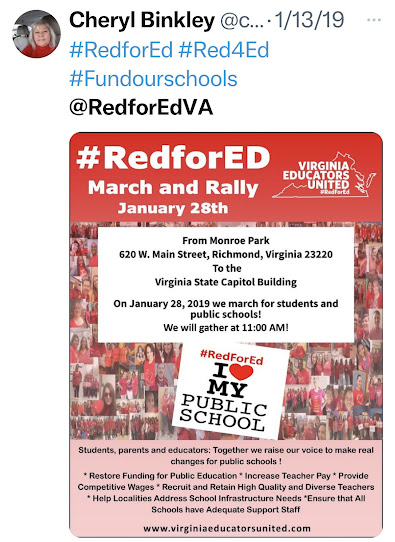
She posted the flyer       👉👉👉

that I shared January 13, 2019, eleven days before the Virginia Red for Ed March, and I'm so glad she did.


Florida had a march, Arizona, Washington State, and West Virginia, but some people said, Virginia can’t do it. Virginians are not brave enough or strong enough. No one cares enough about Virginia’s schools to take such a stand.


But in May 2018, about a dozen dedicated volunteers set about to make it happen. Some were union members, some were not. Virginia Educators United decided first and foremost we would welcome anyone who supported our public schools. We funded most needs for the march, like permits and insurance, with pocket money from our own wallets and what we made off t-shirt sales. 


Across nine months people reached out to one another. Day by day our numbers grew as friends and neighbors came together over time.


They made their plans, “I’m going. Come and go with me,” they said, and they came from Wise and Winchester, from Richmond and Roanoke, from Frederick County and Fredericksburg, from Virginia Beach and Colonial Beach, from Arlington and Accomack.


They had heard Virginia was 47th in state funding for schools while school buildings were crumbling in urban and rural areas. Yet, Virginia schools were delivering stellar learning experiences and results for their students, ranking near the top on measure after measure..


So they came. There were mothers and fathers, grandparents, and teachers, students and friends, administrators and officials, politicians and cafeteria ladies, carpenters, nurses, and electricians. There were people of all races and faiths, different life circumstances, and vastly different economic situations, but we were all Virginians. And all came to say our public schools are important to us and our communities, to our families and most of all our kids.


They came to say the schools and children of Virginia matter. Every child of Virginia, without exception.


On the day of the march, we gathered in Monroe Park, and volunteers had assignments all through the 1 mile parade route. I brought up the back, crisscrossing  through the lines and making sure all was well along the route. 


 When I came near the Capitol grounds, I could hear the roar of the people. So could the legislators in session inside the Capitol. Then I rounded the corner. There were thousands of people; spilling all over the grounds, filling the steps and the pedestals, cheering, with signs and banners waving everywhere. 


Several times lately I’ve been in a space where someone mentioned the Red for Ed March, and each time someone in the room’s eyes lit up and they smiled. “I was there that day.” “So was I,“ says another.


So, I’d like to thank Asra for reposting our flyer because it says exactly who @Red4EdVA is and what we want to support. 


 Seeing it again brought back all the feelings of that day. 


Asra said this is Cheryl Binkley. She is @Red4EdVA. Everyone who knows me knows I am #Red4Ed, but only as one of thousands, only as one of many who do the yeoman's work shoulder to shoulder, proudly.


We have made progress since that day, in spite of a massive global pandemic, and those who would like to practice disaster capitalism on the schools of our commonwealth. Yet, today we need one another more than ever.


Together we can recover and thrive as communities, for the sake of our children and Virginia’s future place in history. You can make a difference.


  • Join a pro-public schools group in your town or county,
  • ask candidates and policy makers where they stand this year on supporting our public schools.
  • Watch for actions and alerts to voice your support for the kids and their education.
  • Don’t be faked out by those who use misleading phrases like “school choice” and name call others as “woke” or commies, or pedophiles, or socialists, or represent parents who only believe some parents should have rights.
  • Maybe even wear Red4Ed to let people know we are proud of our schools.
Listen for the roar of Virginians who believe in the power of learning and a practical, strong and caring education, and relax into the power of solidarity with other Virginians.


A beautiful future is just around the corner.  Be #Red4EdVA.


Thursday, February 23, 2023

Pulling a Fast One

Governor Youngkin’s “College Partnership Lab Schools"

When incoming Gov. Glenn Youngkin came into office in January of 2022, he came in promising “school choice,” as part of his parent power agenda. The leader of the National Association of Charter Schools was there for his early celebratory events, and traditional charter school advocates were ecstatic that Virginia, which had long been known for its excellent public schools would at last be opened to the charter school industry. 

In order to open the market and gain enough traction in his one term, the former hedge fund manager would have to work fast. So Youngkin looked north to DC, and the G street consultants who had been part of earlier privatization efforts there and around the nation.
1341 G St. NW, DC
 Home of DQC

His Secretary of Education would be Aimee Guidera, a data collector whose firm, DQC, had been granted approximately $26 million over the years from the Gates Foundation to convince states and districts to collect complete and longitudinal data on students.

Across a similar time period, Andrew Rotherham  AKA Eduwonk, was supporting Michelle Rhee’s candidacy for Chancellor of DC, and supporting the charters and firings of teachers of her era. " Like most reformers, I greatly admired Rhee’s tenure in D.C., in which she closed failing schools, fired underperforming teachers, and helped raise student achievement."  he said.

He also defended her across the scandals that finally sent her to California. Rotherham was tapped to join the Virginia Board of Education as one of the replacement candidates for the 3 Northam appointees Gov. Youngkin refused to confirm. 

" Like most reformers,
I greatly admired Rhee’s tenure in D.C.,
in which she closed failing schools,
 fired underperforming teachers,
and helped raise stu
dent achievement."
Also, there was Bill Hansen, one of the “architects of George Bush’s No Child Left Behind who came as another of Youngkin’s VABOE appointments. 

But there were a few problems, the first was Virginia schools were not in trouble as former takeover districts had been, but Youngkin was banking on the disaster capitalism of Covid to create the needed crisis.

Secondly, several ALEC model school bills died quickly in Virginia’s General Assembly, possibly due to a year of constant charter school scandals in the news. 

But Gov. Youngkin’s team quickly rebounded with the idea of taking a mostly dormant type of school in VA - The College Partnership Lab Schools- and retooling them as the new name and “innovation” of his term. "we will invest $150 million to kick start 20 new charter schools in the Commonwealth." he declared.

Originally, College Lab Partnerships were designed as part of a teacher training model.  Had Gov. Youngkin proposed keeping them for that purpose, he could have made progress on the teacher shortages which have been growing worse by the day. Instead he removed teacher training programs from the eligibility requirements. 

Very quickly a bill was put forward by Del.Glenn Davis and a budget amendment which went from $300M behind the scenes to $150 million on paper. The 2022 biennium budget in the end would include $100M which must be returned to the general fund if not spent by June 30, 2024. 

Secretary Guidera went into high gear, spreading a “Virginia’s schools are failing” story and reaching out to private Unis, Community Colleges, and traditional 4 year publics to convince them to accept a Lab School in partnership with a business. Nevermind that private universities and community colleges had not been part of the original definition of Lab Schools and were not, according to some legislators, part of the budget agreement. 

By June the Virginia Code was morphing with a series of changes, in spite of no bills that had authorized the changes. Announcements and varied numbers of “approved” partnerships began to appear all across the state, and you had to read to the bottom and fine print to find out the partnering entity had not filled out paperwork when the announcement was published. The Youngkin administration made sure there was a publicity story released about this new innovative type of school roughly every month in national and regional outlets across the state.

By November though, only 3 grants had been approved. The long dormant Lab Schools Standing Committee that had not been reconstituted for 10 years became active with new appointees. Come December, with Elizabeth Schultz as staff, and Rotherham and Hensen as new standing committee members, they were quickly approving new applicants.

Just a couple of problems, the applications were for a preliminary planning grant that did not include the stringent application procedures of a full school approval, and most of the applicants were not proposing a full service school. They were coming with proposals for additional Dual Enrollment tuition support, Coding classes, or Amazon training, or Health sciences programs; the type of workforce programs that the Chamber of Commerce’s Go Virginia! Program had been requesting for several years, and that already existed at most Virginia high schools, unis, and community colleges.

“I don’t care whether you call them charter schools or lab schools,” Youngkin said, confirming that these are indeed charters meant to replace local governance with corporate management. 

This year, again, the legislature refused to pass Del. Davis’ Lab School bill which was considerably more invasive on local school districts’ autonomy than last year’s.  

Will the budget conferees yield to Youngkin’s request to grant another $50 million for workforce training that bleeds already existent career and technology programs in the public schools?

Will the Carlyle-style corporate takeover plan enable the school privatization sector to bring down one of the most preeminent public school systems in the country? 

We wait to see.


Saturday, January 14, 2023

WOKE values are necessary, not political

Yes, public school teachers do teach WOKE values for an essential reason:

To enable our students to become Wide Open to Knowledge and Enlightenment


The values teachers use as a basis of instruction are ones that are necessary to the effective operation of a well organized and effective classroom. WOKE values are basic classroom management, They also contribute to student well-being for a positive and flourishing year. 


Each year the first week or so of classes are dedicated to building rapport among class members and the teacher to set up the conditions which will provide optimum learning conditions for every student in the class. 


We get to know one another. We set common rules together. We establish the goals for the year about what we will learn and be able to do. We begin to establish a rhythm of work that can produce progress toward those goals. We clarify why we are studying the things we are learning. 


Across my career, I mostly taught high schoolers, so by the time students got to my class they had set rules every year for quite a few years. They knew what they wanted a classroom and course experience to be like. 


Together students would set rules for the class. Through a process of brainstorming and refining, rules usually distilled into a few fairly similar items, things like

Respect one another 

Respect our physical space 

Listen when others speak/take turns

Do the work /Participate/Learn


As the teacher, I agreed to keep the same rules, stressing that my goal for the year was that every member of the class learn and feel emotionally and physically safe to learn. So, I committed to not demeaning or discounting their concerns or needs, and to not let others who entered our space do so either. 


In younger grades the process of developing class norms might seem different with simpler vocabulary and more guidance needed.  Sentences like "Be Kind to One Another" might substitute for Respect One Another.  


The point is, certain conditions are necessary if a group of 20-30 people are to inhabit the same space, interact, and work together every day for 9-10 months. Working together requires mutual respect, honest and inquiring interchange, and our best efforts at understanding. In a classroom the elements of respect that seem so missing in external communication these days, particularly in politics and media, are necessities.


WOKE values are not just luxuries to a school classroom. 


So, Yes we do teach mutual respect, kindness, and the practice of understanding; not because they are a political stance or unique religious teachings, but because they are necessary for learning.


Friday, January 13, 2023

No, Virginia Has Not Dumbed Down its Schools

Prince William County Programs

For the last year the chorus of anti-public schools messengers in Virginia have chanted that Virginia has lost it's edge, failed its families, and dumbed down its schools. The anti-PS policy messengers insist they are data driven, but a quick look at the real data from a variety of sources shows otherwise.

Here are some basic points about the accusations being leveled against our Public Schools related to levels of difficulty and reliability of data. 

The Pandemic

Though state tests were waived one year and scores dropped the following, the drop was a national and global one. The problems were predictable for two years of seriously interrupted instruction and widespread traumatic events outside of schools for students and faculties. Projections of recovery have been at least three years.  Some schools are progressing faster than others. Scores are rebounding with the use of ESSER funds and state grants, but it is too early to tell when equilibrium will be fully established. To use scores from 2020-2022 as representations of the systems' stable conditions is misleading and disingenuous of policy makers and political actors.


The Math Question

 In 2014, at the behest of the business and tech sectors, the VADOE expanded the courses that could substitute for Algebra II to satisfy requirements for an advanced diploma to include courses like computer science, statistics, and economics. Students still have to pass 3 high school math courses to qualify for an advanced diploma. 

https://www.pilotonline.com/news/education/vp-nw-virginia-advanced-math-classes-20210427-lodz7o7gqzgqpidmgzpqt4y6pq-story.html


Currently these are the advanced diploma requirements. 


The Virginia Mathematics Pathways Initiative program which is under development has been highly criticized by Fox News and other conservative outlets. According to UVA developers it does not eliminate options but modernizes with more contemporary math applications and adds options. 


The National Scenario

 The following accusations are being levied across the nation and are originating from national libertarian think tanks and strategists. 


The Honesty Gap 

Gov. Youngkin’s administration came in advertising Virginia had an  “honesty gap.” The idea hinges on differences between state tests and the NAEP.  And poses the idea that schools are deliberately misleading parents about how well their students are doing. The “Honesty Gap” Is affiliated with Achieve, Inc. and The Collaborative for Student Success, privatization organizations. The hypothesis is not considered factually defensible by most academicians and educators. https://honestygap.org/what-is-the-honesty-gap/


The NAEP Comparison

The NAEP is the federal DOE’s test. Each subject field is given to a random selection of students across the country every three years. They do not test all students in all courses. The most recent NAEP tested just under 3,500 Virginia students (less than 1.9%).  In Fairfax County 476  were tested out of 181,109 students from 23 schools out of 200. (1.8%) 


As you can tell from the 2019 4th grade Math snapshot, Virginia students scored lower than only 1 state in the nation. They scored as well as, or above the other 48. Though scores dropped on the 2022 NAEP, Virginia still scored above the national average.


For reference, according to the Brookings, NAEP’s proficient category is above grade level, not on grade level. However, even allowing for proficiency being higher than grade level, Virginia’s performance on the NAEP is not low. Our rankings on the NAEP for the last three rounds has been above the national average.


The “Virginia is 50th” story

The administration’s messengers have been saying that Virginia ranks 50th on the NAEP. That is not true. Here is the chart they use to show that message. This analysis compares how similar state assessments are to the NAEP. There are two national companies that provide state assessments which are much more tightly aligned with the NAEP than others. Those tests are the SBAC and the PARC. This study does not report any actual student scores, or actual state performance, only the perception of the researchers as to whether the state test is similar in difficulty to the NAEP.  Virginia uses Pearson and develops our own rather than using other pre-packaged standards and tests. 


The NAEP acknowledges that 22 years of the NAEP has not significantly improved reading outcomes or closed the achievement gap. Which calls into question whether mimicking the NAEP would provide any improved outcomes for Virginia.


When they are ready to graduate.

Virginia outperformed 49 out of 50 states on the 2021 SAT report. Here’s the chart. 


https://worldpopulationreview.com/state-rankings/best-states-for-education


Advanced Academic programs and career path programs in Virginia. 

In Virginia's 133 schools districts we have: 


19 Academic-Year Governors Schools (Schools for highest performing high schoolers)

There are 9 Career and Technical Education Centers around the state. 

All 40 Community College sites offer Dual Enrollment courses in conjunction with surrounding districts in both academic and career courses.

We have 78 International Baccalaureate programs around the state.

Virginia Schools rank 6th nationally in students taking and passing Advanced Placement classes 

Virginia offers a huge number of  Career and Technology programs serving 670,000 students per year.


As an example- 

Courses Fairfax County offers for Career and Technical certifications

24 courses in Business and Technology

17 Different courses in Family and Consumer Sciences (Culinary and Childcare) 

27 courses in Health and Medical Sciences 

12 courses in Marketing

23 separate courses in Technology and Engineering

44 in Trades and Industrial Education


At the state level there are 17 different fields of study for CTE certifications with numerous choices under each of the 17 categories, similar to what is offered in Fairfax.


 Other Background


The Predictable State SOL cycle

As we update our standards for each subject field on a rotating basis every 7 years, scores fluctuate based on the time and resources it takes to re-align to the new standards. 


In year 1 and 2 after the update there is often a drop in scores as teachers adjust their focus away from things that were in the old standards to items in the new. Changes in scores can also be a reflection of newly introduced testing conditions such as new computer interfaces.


There can be a fluctuation some years based on the test makers shifting from one sub-set of the standards to another. For instance, 4th grade math has 16 overall standards, but has an additional 30 secondary standards underneath those.  Not all the 46 elements will be tested any given year. With between 32 and 42 questions each for each test, it takes a bit for the districts to recalibrate. 


Race, Poverty, and Equity

Overall, Virginia has been fortunate that it had in place strong systems for adapting to changing conditions, and strong general support for its schools. Pre-K systems need enhancement and strengthening, and weak state funding for districts has made closing achievement gaps and building a fair system for every Virginia student more difficult. Substantial numbers of our districts are high needs due to economic conditions and unique profiles. And our buildings are aging and need upgrades.


If Virginia is to meet its constitutional aspirations of the highest quality education for every student, it will be necessary to stop throwing insults and making accusations. Only a clear-eyed look at what our students need, what works, and rebuilding what was once a teaching workforce envied by the nation will lead us in a positive direction.


Saturday, October 15, 2022

Our Children Are Listening

There is a political strategy underway to demonize the people who teach our children. Daily on social media platforms, on major media outlets, and in public forums, we see and hear people accusing public school teachers of deliberately destructive and dangerous practices.Teachers are called offensive names, accused of the lowest crimes, and portrayed as dangerous and untrustworthy. Our commercial media and social media are permeated with this narrative. 

Most who spread these perspectives say they believe one of three things: 

  • They are preserving their own primacy as teacher of their children,

  •  that they are gaining political power against an ideology, 

  • or in some cases that they are actually protecting their children from ideas and people that would harm them. 

There are many things children learn across their time in school, from basic numbers to calculus; from letters and words to Shakespeare; of events in history from roughly 6,000 bce forward; and science from washing our hands to avoid disease to the orders of plants and animals to the vastness of the universe.

For thirteen years our children learn about the amazing wonder of our world from their teachers. Most will learn with at least 30 to 40 different teachers in K-12, each of whom will be trying to share new and sometimes difficult learning with them, most of which has little to do with politics.

Learning is an intensely personal and individual interchange. For we humans to learn we must be able and willing to access the knowledge when it is presented. For a teacher to be effective, they must find a way for each student to be able to hear and understand their offered knowledge and wisdom. 

Yet, as a society we are telling our children:

  •     Don't trust your teachers.
  •     Don't believe what they tell you.
  •     Don't cooperate with their lessons.

For learning to happen, a student must have some modicum of trust that they can believe and rely on the person delivering the information and skill, that the teacher is presenting something of worth and value for their benefit.

By demonizing the people who teach our children, and by media amplifying those characterizations, we are not just disrupting institutions, or simply changing the venue where our child might attend classes. 

  • We are convincing our children that they should not learn.
  • We are destroying the very basic prerequisites for learning.
  • We, as a culture, are striking at the heart of every child’s chance to learn.
  • We are diminishing the future of our own children.

Children cannot learn when they believe the person teaching them means them harm, and that their loved ones and community would disapprove if they do.

Tuesday, September 27, 2022

Whose Adolescence is it? A Reflection on Policy and Parenting

From the first moment you hold your child in your arms, the emotional impulse is, "I must protect this tiny person in every way." It is a common response of both biological and adoptive parents of infants.

For most of their infancy and toddlerhood that imperative to protect them remains dominant in our hearts. But their gradually increasing need to venture out, to become, challenges our sometimes overwhelming need to protect.


Every ‘first’ is an adjustment for us as much as an achievement for them- first steps, first visit without us, first sleepover, first days of school, first bike ride, first game. Through most of childhood those conflicting needs--theirs to launch out, ours to protect-- can be balanced. Then comes adolescence. 


According to the University of Texas Medical Branch, “An adolescent has four tasks to accomplish to become a well-adjusted adult. These tasks are categorized as: 1) independence, 2) body image, 3) peer relations, and 4) identity.”


In lay terms that means teens must choose their own levels of risk (independence), resolve how they relate to their bodies (body image), learn what being a friend means (peer relations), and figure out how to be an individual, themselves- beyond their family and culture--Who am I, beyond who are we? (identity)


"How can I be me and fulfill what my family expects of me?" can often become the critical question for teens. The wider the difference between what we want them to be and their own aspirations and sense of self, the harder it is for them to become their most, best selves.


The potential cost of disappointing us can be almost overwhelming for our children.Yet, their adolescent growth tasks mandate that they must make more of their own decisions, launch into new territories, and challenge our protective shells. This is true for LGBTQIA+ kids and for heteroromantic or cisgender kids.


What has been startling about recent political culture clashes is they almost all revolve around the four necessary areas of growth for teens and how that challenges parents. It is almost as if some would intrude on our most complex and personal parent-child relationships and have us as a collective society renegotiate the path to adulthood for our children, taking away choices in all the developmental growth categories they must engage in.


From questions like- What clothes should I wear, or what books will I read, to who am I physically attracted to, or what name really feels most me- “Who am I, and how does that fit with my family, friends, and world?” resounds in almost every experience adolescents have.


We can, as caring adults try to guide and support our children in their quest, but at a deep level their internal mandate is to figure it out for themselves. We may be temporarily successful in denying them their own selfhood, but only at the expense of their long-term dissatisfaction, struggle, and adult dysfunction.


No amount of legal or societal restrictions and suppression can negate that necessity to become their own persons. Neither parents, nor teachers, nor society as a whole can deny that need, and it is only damaging foolishness to try.

As they grow, it turns out, the best way to protect that tiny person we first hold in our arms is to nurture the internal person they are discovering, rather than demanding they manifest the person we imagined or try to insist they be.


Friday, September 9, 2022

Let Teachers Fix this. They Know How

For the first 6 years I taught, my classes were made up of students with IEPs who entered class reading on average between 5th grade and 7th grade levels at the beginning of 10th grade.. (I know grade levels is old fashioned terminology, but most people understand grade levels better than lexiles, stanines, or other types of scoring bands). 

In other words, for every year they had been in school, they had made 6 to 7 months of reading progress. I was told to align as closely as possible with the general education curriculum and do what I could to raise performance.


After initial reading and writing samples to assess each student’s skills, the course was designed to fill in the skill gaps, get them as much reading and writing practice as possible and convince them again of something they had lost- a belief in their own ability to learn. 


The design was detailed and focused on the students in the room, not on an external testing goal. 


Classes centered around 6 key practices

1. We set classroom rules together as a mutual agreement about how we would act and be together and posted them for all to see. The rules often leaned heavily on mutual safety within the space. I agreed to treat them the way we all agreed to treat one another. We included in that agreement how we would treat our space and materials.


2. Food and Drink were allowed, and provided.  A hot chocolate station with granola bars was set up, 1 drink and 1 food item per class session. - So long as students cleaned up after themselves, took nothing outside the classroom, and were ready to work at their desks when the bell rang. Not being hungry or thirsty was step one in being ready to learn. 


3.We would work on reading and writing from bell to bell and would limit homework only to what could not be completed in that concentrated class time. One outside assignment was that every student would select a library book of over 100 pages and do an oral book report each quarter.


4. Writing prompts and reading pieces were selected for quality, the students’ areas of interest, accessibility, and progressive complexity from a variety of genres. Key skills of working words, sentences, paragraphs, figurative language, and narratives were developed in context of those daily practices. The goal was for maximum engagement.


5. All students could sign up for to use the classroom bank of computer stations as soon as they finished their writing and reading assignments for the day. (6 donated computers, had been upgraded to be fast enough for educational games. The in-class lab was equipped with games for building vocabulary, developing sentence structures, and identifying key ideas in reading. They were lively and had a high fun factor. There were also academic supports like encyclopedias and dictionaries. In those days, before networking and smartphones, computers were the privilege of comfortable families. Few students had access to fully equipped computers at home, and few rooms in the building had student-use computers.)


6. Assessments were based on the work we did, not on commercially designed standardized tests, except for beginning of year, locally developed grade level mid-terms, and final reading assessments. We did not orient daily work as specific test prep.


Those who know me, know that I don’t like to rely on one-day test scores as a stand alone evaluation, but given the other performance measures corroborating, I’m ok with sharing this one as a short-hand for the wide range of performance changes we saw. 


At the end of the year, most students had made at least 1 full year’s reading progress on the Gates-McGinitie reading test- twice what they had normally made in prior years.  Many students made 2 to 3 years of progress -jumping from 5th grade to 8th or higher in comprehension-  3 to 6 times the growth they had made in the past. Those who entered at 7th or 8th level often reached end of 10th levels. An important note is that these growth numbers occurred in classes of 15-17 students, not the 25-35 commonly seen in gen ed classes.


The point of this piece is not to say I was an extraordinary teacher.  I am/was an ordinary teacher following well-known and common pedagogical practices. If you talk with other teachers they will have similar stories. This is the kind of work teachers do-or can do when given the pedagogical freedom to meet our students’ needs. 


In light of this ability that even ordinary teachers have, media coverage and panics about “learning loss” with recommendations about holding students back, and imposing mandates from above sound just plain uninformed and fool-hardy.


For over twenty years, policy makers and administrators have increasingly insisted teachers follow administrative not instructional protocols. It is time to let teachers manage the post-pandemic academic recovery.


There are a handful of changes that can provide the opportunity to put this 2 year tragedy in the rear view mirror for our children. 


1. Set up full school Faculty Councils in every school that will assess the needs of their students and develop the design and implementation of post pandemic recovery.  Let grade and subject level teams provide input and representation on that council. Center teacher, not administrative, expertise in the decision making.


2. Suspend new purchase of statewide, and district wide tests, materials, and apps. Instead utilize pandemic, training, and assessment dollars to fulfill the recommendations of those local Faculty Councils for what they need for their students, and stop telling teachers what they can’t teach. Each class will have a wide spectrum of needs. Teachers will need the flexibility to differentiate.


3. Spend the necessary money and change policies to attract teachers back into the classroom; teachers who know how to do this, not random applicants without knowledge. Attracting teachers will mean shifting any regs that demean and disempower teachers back to ones that respect their skills and autonomy. 


4. Find teachers who reflect the range of student ethnicities and economic class. To believe they can learn, students need to see and be around people who look like them and are learned. 


5. Reduce class sizes, and lower administrative work for teachers to enable them to meet student and parent needs. Parents will be happier if they can feel their child’s teacher can be responsive to their child’s needs.


6. Increase the number of counselors, to provide support for the more intense family and student trauma-stress.


7.  Quit sending in businessmen to take over and loot the public schools. It creates constant stress and distracts from the major project at hand to bring our students and communities back into academic and personal equilibrium. 


Learning is not lost. It may be delayed and require localized intervention. Panic after a crisis is not productive. Let the physicians treat the wounds.